
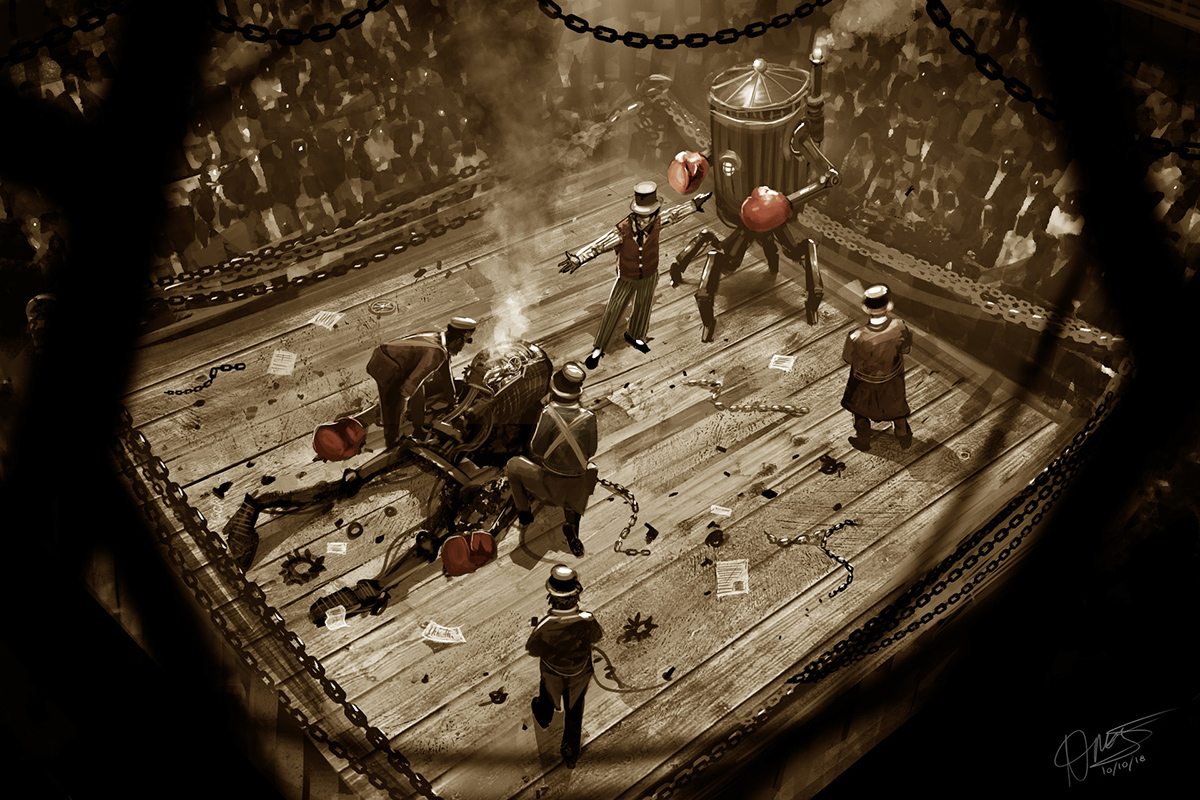
Tor.com‘s Steampunk Month is over. For the last four weeks, the website has published an impressive collection of artwork, essays and fiction that has kept us thoroughly entertained.
About midway through, one article appeared I would like to comment on.
In “There is Totally Punk in Steampunk,” Jaymee Goh writes about how the ‘punk suffix relates to the genre and the developing subculture that we understand today under the banner of “steampunk.”
Literary roots
She reminds readers that steampunk’s roots are literary; costume and cosplay, while appealing and amusing, were not originally part of steampunk. Up until the late 1990s, only books, some anime and maybe a handful of films were.
That is not to say costume and cosplay shouldn’t be considered steampunk. Rather, what was originally a genre has become a movement that encompasses more than books. Goh seems to believe steampunks have forgotten that.
“Some of us like tackling the hard issues,” she notes, which include class schisms, colonialism and imperialism and presumably related topics like racism and sexism that were prevalent during the steampunk era.
In other words, there are steampunk enthusiasts who like to mingle their hobby with a bit of politics and there is no harm in that. We occasionally do the same thing.
“Simply” Neo-Victorian
Goh goes a step further, though, and declares that, “To write about the hard issues then is also writing about the hard issues today.”
In other words: by discussing period politics one implicitly discusses modern-day politics.
What these modern-day politics entail, the article does not say. Goh vaguely adds that, “some of us are actually activists,” but practically leaves it at that after concluding: “Some of us put the punk into our steam, and some of us steam up our punk.”
Very well. We beg to differ and gladly debate the issue, but let’s not pretend that those who “put the punk into our steam” are somehow rescuing the rest of steampunk from descending into “simply being Neo-Victorian,” as Goh puts it. Neo-Victorianism is not the same as steampunk without the punk. It is the anachronism that made steampunk different from Neo-Victorianism in the first place, not an association with political activism.
Frustrating
Goh takes offense at those who “run around” telling people there is no punk in steampunk. “It erases those of us who feel there is.”
Hopefully, she’ll understand that to those of us who feel there isn’t, people who “run around” proclaiming that activist politics are inseparable from steampunk is equally frustrating.

7 Comments
Add YoursI do agree with Goh. Here’s why:
First, steampunk is said to be more than cosplay, it’s roots are literature. That is true.
Now, if literature is taken as the core of steampunk, one has to look at the steampunk stories of yesteryear (1975-2003) and today (2003-2011). And even in the most amateurish texts, there are hints to politics. Maybe not the big politic issues, but issues like:
– the role of women in society, emancipation. Many stories have a female genius and explore the possibility of leading ladies in a Victorian society. Maybe the many explorations of a more liberal appraoch to sex can be put in here, too.
– environmentalism. Where there is industry, machinery and steam, there is pollution.
– socialism. Steampunk hints at a class-based society. Many stories deal with the role of servants, slaves, labourers, and robots in society. Though not always too specific, the writers has to think about the roles of masters and servants, and how they make a society together.
– royalism (or whatever you call it). Whenever a Queen Victoria shows up, how does the author deal with it? What role has royalty in steampunk literature? And if a story involves revolutionary elements, as The Difference Engine has, how endangered are the royals? And who are the good guys in the revolution? What views does the author have on the politics in Europe, the world? For example, how are the French or the Prussians portrayed?
A writer has to build a world. A world has a great deal of society in it. A steampunk author has to design a “Victorian” world with modern elements. Each element has to be weighed: how modern can it be, and how does a modern element influence the Victorian society? Or the other way around: how much of Victorian society can be put into the modern world? In each of these decisions the author makes a political point. Again, maybe nothing revolutionary or as a way of activism, but nonetheless a point of view that reaches the reader and is an issue to think about, at least briefly.
And as far as I’ve read steampunk literature, the authors do give the impression that these points of view are not merely a decoration for the story. It’s some kind of message they want to get across. Yes, activism in literature, hidden under a good story.
Jack, I think your approach is reading too much into a setting that is defined a) by historical circumstances and b) by modern-day views.
True, women feature more prominently in steampunk literature than they do in period literature, but is that a statement of feminism? I doubt it. I think it’s a reflection rather of the emancipation that we’ve experienced in our time. (Which, of course, is a good thing!)
Similarly, merely writing about industry and pollution — because it was there — doesn’t mean that the author has a “hidden” message about industrialism and environmentalism.
Now, if a steampunk story were set in a nineteenth century totally devoid of pollution, that may hint at a political statement. But to claim that steampunk is inherently political (and radically political at that) based on “hidden activism” in steampunk literature? I’m not convinced.
Well, I’m convinced. As a writer, the easiest way is to copy reality. Steampunkwriters don’t.
I see it in my own works: each and every story has something to say about todays life (politics, society). There is no point in putting todays society into the life of the Victorian Age (or the other way around) unless you want to make some kind of statement.
How about just fun? What’s the statement in The League of Extraordinary Gentlemen?
Nick,
I’m with you.
All good fiction is involving, and to be involving it has to have high stakes. That means things which matter not only to the characters but also to many others, possibly to society as a whole. As a result stories quite often deal with political issues and, if they are good, they do so in ways which resonate with the contemporary reader.
But that is true of every genre of fiction. That does not make every genre of fiction punk.
What distinguishes steampunk from other genres is its setting. Yes, the origin is literary, but my understanding is that when th K.W. Jeter coined the term, he did so as a collective description of stories with a similar technological setting, not a distinctly political outlook, ethic, or sensibility. Those are things which each author brings to the work on his or her own.
Unless you actually believe that everything is political, there can be other reasons for X being Y in a steampunk (or any other) story. For instance, the author may want to be as historically accurate as possible to make the fantastic more believable; a certain choice may fit the story to be told better; it may be something that the author didn’t give much thought – or got it wrong; or the the author did it that way to avoid making a political statement; or there might have been some other reason.
If you read people analysing, e.g., sci fi tv-series, you often find that things they consider significant and draw many a conclusion (some political) from were the result of practical considerations (typically a lack of money requiring reuse of props, a single shooting location, the avoiding expensive SFX, etc.). And there is the rather infamous political analysis of the Smurfs, the author of which, Peyo, seems to have been a rather apolitical person. Sometimes a cigar is just a cigar and not political message (and sometimes it is).
And as observed above, this is true of all genres. Though, the Victorian setting and the freedom to reinvent the past seems to invite political analyses to frightening degree: is there the same readiness to interpret politically and ascribe radical political views to historical novels and Holmes pastiches?
I must point out that Nick is completely correct about the etymology of the affix -punk in steampunk and dieselpunk. It is based on technological anachronism or alternate time-lines, not on any sociopolitical agenda per se, which does not preclude said elements from becoming prominent elements, but they are contingent elements rather than necessary ones.
While it is not necessary that politics be inferred in steampunk , I think it is obvious that the undercurrent is there in some of the stories, and not just in reference to setting the scene of the period. One of the defining works of the genre, The Difference Engine, is rife with politics, both as story element and meta-narrative. The graphic and extensive depiction of a disastrous air pollution event blanketing London is more than just atmosphere (pun intended).
The conclusion of the book leaves little doubt that a comment is being made about the interactions of class/economics, industry/environment, and questions pertaining to the place of humans in a projected arc of technological development (re culture, transhumanism, etc).
The song “The Watchmaker’s Apprentice” by The Clockwork Quartet is a good example of allusion to politics in steampunk music, as is “Coin Operated Boy” by the Dresden Dolls.
Even in SOME of the fun output, dieselpunk films such as Indiana Jones, Captain America and others, there are elements of politics in the background. In those cases, it is left to viewers to draw analogies or not.
The League of Extraordinary Gentlemen may not have much politics in it (it is thoroughly entertaining without it), but Abraham Lincoln, Vampire Hunter has plenty and it is also good skull candy. There is room for both, sometimes simultaneously. Consider music by Abney Park- It makes you think, and you can dance to it.